Pillar 05 · Field note
AI Won't Replace Great Businesses. Poor Systems Will.
AI will make the gap between well-run and poorly run businesses more visible — and much more expensive.
Will AI replace my small business?
Every week I talk with owners who have built something real. Ten, twenty, sometimes forty people on payroll. Loyal customers. A reputation earned over years.
And a lot of them are carrying the same quiet worry: Am I already behind on AI?
I understand where that comes from. A new tool gets announced every few days, and plenty of loud voices online insist that anyone who doesn't adopt everything immediately is finished. If you're running a business and don't have time to track all of it, that message lands as pressure.
I want to offer a calmer, more useful way to look at this. It comes from 35 years in enterprise operations, including senior management at a Big Four Corp, and from watching several waves of “this changes everything” technology move through real companies.
AI is unlikely to replace a well-run business. What it will do is make the gap between well-run and poorly run businesses much more visible, and much more expensive.
The good news is that the second problem is fixable. And you're more capable of fixing it than you've been led to believe.
I've Seen This Pattern Before
In every technology wave, the winners weren't the ones with better tools — they were the ones with clearer processes underneath.
Earlier in my career, the big wave was enterprise resource planning systems. Later it was the move to the cloud. Then workflow automation. Each wave arrived with the same promise and the same anxiety.
Each time, the outcome followed a familiar pattern.
Some companies absorbed the new technology and got faster. Others spent significant money, sat through months of implementation, and ended up with the same problems they started with, now running on more expensive software.
The difference was rarely the technology. Both groups often bought the same tools.
The difference was what the tools were placed on top of.
Companies that understood how their own work flowed got real value. They knew who owned each step, where handoffs happened, and what “done” looked like. Companies where work lived in people's heads, where approvals depended on who was in the office, where the same question got answered three different ways, mostly bought themselves a more complicated version of their existing problems.
AI is following that same pattern. It's just moving faster.
What AI Actually Does to a Business
AI amplifies whatever is already there — a clear process gets faster, a messy one gets messier.
The most useful way I've found to think about AI in a small business is this: it amplifies whatever is already there.
If your customer onboarding is clear and consistent, AI can take over the repetitive parts. It can draft the welcome emails, schedule the kickoff call, and send the reminders. The process gets faster and the customer experience improves.
If your onboarding is different every time depending on who handles it, AI has nothing stable to work with. You'll get automated messages that don't match what actually happens next, customers who get confused, and a team that stops trusting the system and goes back to doing it by hand.
Same tool. Opposite results.
This is why I'm skeptical when a business tells me it has “adopted AI.” Often what that means is that a tool was bolted onto a process that was already broken. It creates the appearance of progress while the real bottleneck stays exactly where it was.
I call that AI theater. It's common, it's expensive, and it's what actually leaves businesses behind.
Where Small Businesses Quietly Leak
Three places: follow-up nobody owns, slow response time, and an owner who approves everything.
When I look at a service business that's struggling to grow, or an owner who feels stretched thin, the problem usually shows up in one of three places. Each one carries a different cost.
Leak 01
Follow-up that nobody owns
A lead fills out a form. A customer asks for a quote. A past client mentions they might need help next quarter.
Then nothing happens for a few days, because it wasn't clear whose job the next step was.
This leak costs time, and it costs trust. The work of chasing things down lands on whoever happens to notice, which is often the owner.
Leak 02
Response time
In a fast-moving market, the business that responds first usually beats the business with the better answer that takes a week to send it.
Most owners know this instinctively. What they often don't know is how long their business actually takes to respond, because nobody is tracking it. A quote request might sit in a shared inbox, get forwarded twice, and wait on a pricing decision before it goes out.
This leak costs revenue. It's also hard to see, because you never hear from the customers who quietly went elsewhere.
Leak 03
The owner as the approval point for everything
This one is the hardest to see from the inside.
An owner's job is to set direction and make the calls that genuinely require their judgment. In many small businesses, though, routine decisions still route through the owner. Small discounts, scheduling changes, minor purchases, standard replies to common questions. Everything moves at the speed of one person's inbox.
This leak costs the owner's time and attention, which is the scarcest resource in the business.
Notice that none of these three are technology problems. They're systems problems. And each one, once fixed, creates exactly the kind of clear, repeatable process where AI becomes genuinely useful.
How to Prepare Instead of Worry
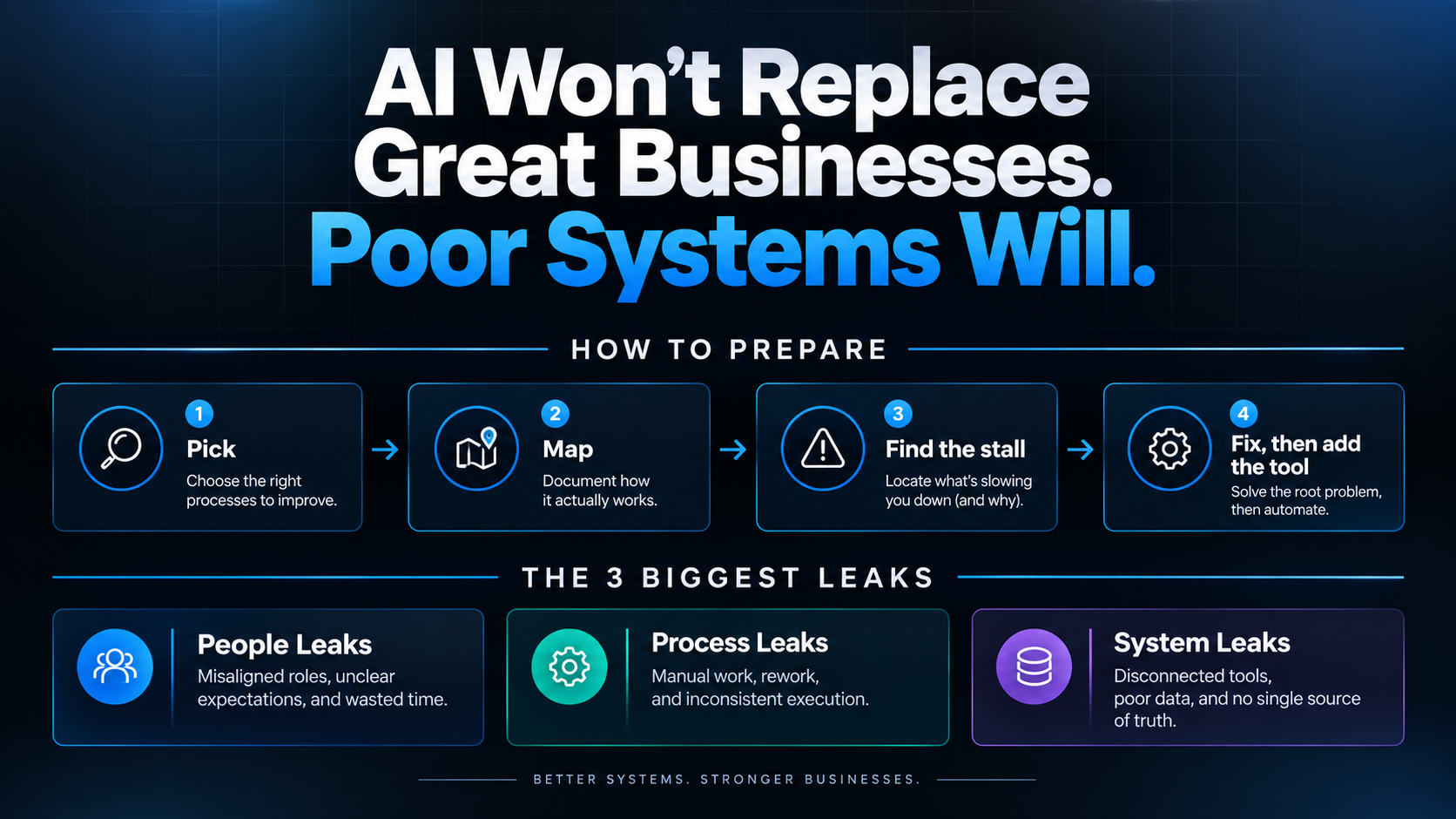
Start with one revenue workflow: write down how it really works, find where it stalls, fix the handoff, then add the tool.
Preparing your business for AI doesn't start with choosing tools. In order to get real value from AI, the right approach is to start with one workflow and understand it clearly first.
Here's a practical way to do that.
Pick one workflow that touches revenue
Don't try to transform the whole business at once. Choose one process where improvement would show up in your numbers. Customer follow-up is usually a strong starting point, because it affects both revenue and your own time.
Write down how it actually works today
Not how it's supposed to work. How it actually works, including the messy parts. Who touches it? What triggers each step? Where does information get typed in twice? What happens when someone is out sick?
This step alone often surfaces the problem. Many owners spot the bottleneck just by seeing the process written out in front of them.
Find where it stalls
Look for the waiting. Where does a task sit until someone gets to it? Who is waiting on whom? Where does a decision have to come back to you?
Name the bottleneck honestly. Once the real problem is clear, the right fix is usually obvious, and you avoid spending weeks comparing tools for a problem you haven't defined.
Fix the handoff, then add the tool
Clarify ownership first. Decide who is responsible for each step and what a standard response looks like. Give your team the authority to handle routine decisions without waiting on you.
Then ask where a tool can take over the repetitive parts. With a clear process underneath it, AI can draft responses, send reminders, route requests, and flag anything that genuinely needs your attention.
When a bottleneck has more than one reasonable fix, start with the simplest one that actually clears it. You can always build something sturdier later, once you've seen what works in your business.
What This Means for Your Role as the Owner
Your business still needs your judgment. Good systems free you from routine calls so you can focus on the ones that matter.
There's a popular pitch online that AI will give you a business that runs without you. I don't buy it, and I don't think you should either.
Your business needs your direction and your judgment. That part doesn't change.
What should change is where your attention goes. The goal is to free you from the routine calls that don't need you, so you have more time and energy for the ones that do. Pricing strategy. Key hires. Which customers to focus on. Where the business goes next.
Knowing which decisions are which is a skill, and it's worth developing deliberately. Hold on too tightly and you become the bottleneck. Let go too far and the business drifts. Good systems draw a clear line between the two.
You're Not Behind. You're Early to the Part That Matters.
If you've built a business that serves customers well and employs good people, you already have the most important ingredient. You know your operation better than anyone. You know your customers, your numbers, and where things tend to go sideways.
What you may not have had is a clear way to look at your operation, and a starting point that doesn't require becoming a technologist.
That's the real work of preparing for AI. It's operational work, and operators are well suited to it.
The businesses that struggle over the next few years won't be struggling because they missed a tool launch. They'll be struggling because their systems couldn't support the tools they bought.
The businesses that thrive will be the ones that took the time to understand how their work actually gets done, fixed the handoffs, and then let AI accelerate a process that was already sound.
That work compounds over time. A tool trend doesn't.
Where to Start This Week
Pick one workflow. Write it down. Find where it waits.
That's enough for now. You'll learn more about your business in an hour of honest mapping than in a month of reading about the latest AI release.
If you'd like a second set of eyes on it, I work with established service businesses to find where their operation is quietly leaking and identify practical fixes, including where AI fits and where it doesn't. You make the calls. My job is to help you see clearly enough to make them well.
Common questions
Will AI replace my small business?
AI is unlikely to replace a well-run business. It makes the gap between well-run and poorly run businesses more visible and more expensive.
Am I already behind on AI?
Not if you focus on the part that matters. Preparing for AI is operational work — understanding how your work flows — and operators who know their business are well suited to it.
Why do some businesses get value from AI and others don't?
AI amplifies whatever is already there. A clear, consistent process gets faster; an inconsistent one produces confusing automation and a team that stops trusting it. Same tool, opposite results.
What should I fix before adding AI tools?
The three common leaks: follow-up nobody owns, slow response time, and the owner as the approval point for everything. These are systems problems, not technology problems.
How do I prepare my business for AI?
Pick one workflow that touches revenue, write down how it actually works today, find where it stalls, fix the handoff, and then add the tool.
Will AI let my business run without me?
No. Your business still needs your direction and judgment. Good systems free you from routine calls so you have more time for the ones that matter.