Pillar 01 · Field note
Where AI Fits Inside a Small Business Operation (and Where It Doesn't)
The better question isn't which AI tool to use. It's where AI belongs inside your operation.
Where does AI fit in my small business?
Most conversations about AI in small business start with the wrong question.
Owners ask, "Which AI tool should I use?" Vendors are happy to answer. There's always a new platform, a new assistant, a new feature that promises to save hours every week.
The better question comes first: where does AI belong inside my operation?
That question matters because AI isn't a department or a strategy. It's a capability you place at specific points in how your business already works. Put it in the right spot and it gives you back time, speeds up your response to customers, and takes routine decisions off your desk. Put it in the wrong spot and you get AI theater: a business that looks modern and runs exactly the same as before.
Over 35 years in enterprise operations, I've watched every wave of technology follow the same arc. Companies install the new system on top of the old process. They wonder why nothing improved. Eventually, they do the harder work of fixing the process underneath.
AI is following that arc right now, only faster.
This article gives you a practical way to skip the expensive middle part. You'll get a simple map of your operation, a four-question test for any task, and a clear view of what should stay human.
Why placement matters more than the tool
Tools dropped on top of a broken workflow only speed up the dysfunction.
Say your follow-up process depends on one person remembering to check a spreadsheet. An AI tool that drafts follow-up emails won't fix that. The emails will be well written. They'll also go out late, or not at all, because the real problem was never the writing. Nobody owned the trigger.
Most owners who feel disappointed by AI are dealing with exactly this. The tool works. The placement doesn't.
So before we talk about where AI fits, it helps to see your business the way an operations person sees it: as a set of workflows where work moves, waits, and sometimes gets dropped.
Step 1: Map your operation into four zones
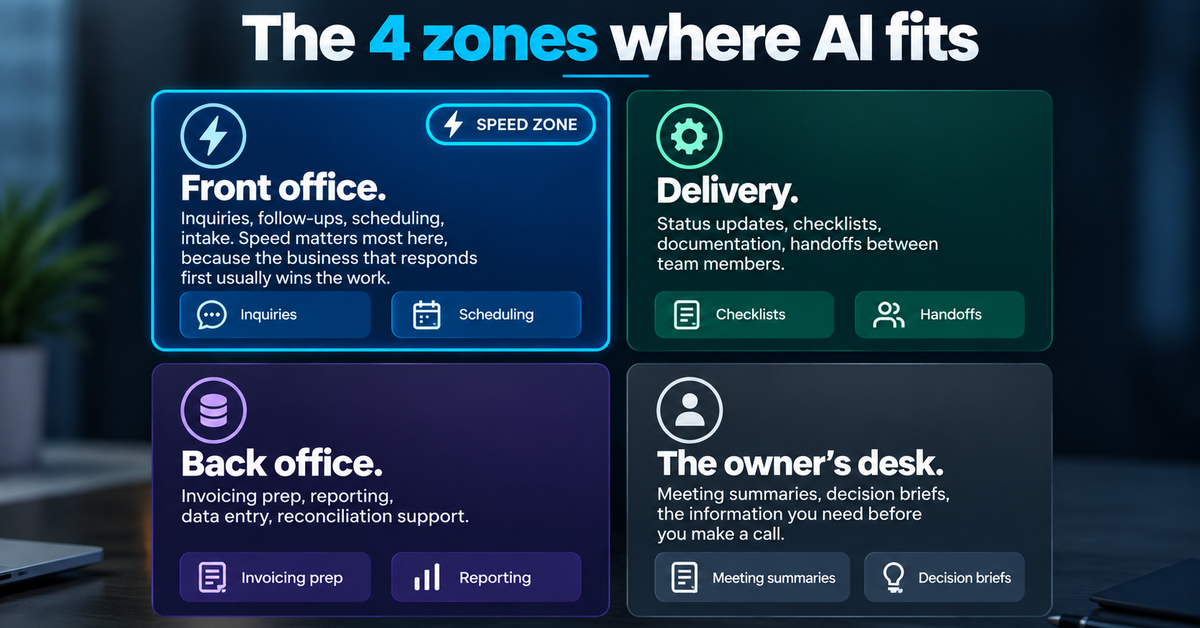
Most service businesses with 5 to 50 employees break cleanly into four zones: front office, delivery, back office and the owner's desk.
Zone 01
The front office
Everything between a potential customer reaching out and becoming a client. Inquiries, intake forms, quotes, scheduling, follow-ups.
This is where speed matters most. In a fast-moving market, the business that responds first usually beats the one with the better answer that arrives a week later.
Where AI typically fits: drafting first responses to common inquiries, summarizing intake forms, sending reminder sequences, and organizing leads so nothing sits unanswered over a weekend.
Zone 02
Delivery
How the work actually gets done once the client says yes. Job checklists, project updates, handoffs between team members, documentation.
Where AI typically fits: turning job notes into client-ready updates, drafting SOPs from how your best people already work, building checklists, and summarizing project status for the team.
Zone 03
The back office
Invoicing prep, reporting, data entry, reconciliation support, internal admin.
Where AI typically fits: pulling numbers into a standard weekly report, flagging overdue invoices, categorizing expenses for your bookkeeper to review, and drafting routine internal communications.
Zone 04
The owner's desk
The information you need in order to make good decisions. Meeting summaries, weekly snapshots, briefs on a problem before you weigh in.
Where AI typically fits: preparing you. Summarizing the week, organizing the facts behind a decision, drafting the first version of a plan for you to edit. It speeds up your thinking. It doesn't replace it.
Take ten minutes and list your recurring tasks under each zone. Don't filter yet. Just get them on paper.
Step 2: Run every task through the four-question fit test
Four yeses means a strong AI candidate. Any "no" points to the process fix that comes first.
- Is it repetitive? Does it happen daily, weekly, or with every new client?
- Can the rules be written down? Could you explain to a new hire, in plain steps, how it's done and what "good" looks like?
- Does someone clearly own it? Is one person responsible for it happening and for the result?
- Is a mistake cheap to catch? If AI gets it slightly wrong, will a person notice before it causes real damage?
Four yeses means the task is a strong candidate for AI.
One or more no's means the task needs process work first. That isn't a failure. It's the most valuable thing this exercise tells you, because each "no" points to a specific fix.
| If the answer is "no" to… | It usually means… | Do this first |
|---|---|---|
| Repetitive | The task is too infrequent to be worth automating | Leave it alone for now |
| Rules written down | The process lives in someone's head | Document the steps |
| Clear owner | There's an ownership gap no tool can fix | Assign one owner |
| Cheap to catch | The stakes are high | Let AI assist, with a person reviewing every output |
This test is deliberately simple. You don't need a scoring matrix or an elaborate framework. You need honest answers to four questions about work you already know better than anyone.
Step 3: Find the leak before you pick a fix
Start with the cost that hurts most right now — lost time, lost revenue, or your own lost capacity.
The map tells you where AI could fit. This step tells you where to start. I ask owners three questions:
- Where are you losing time on follow-up tasks?
- Where are you losing customers because of late responses?
- What manual work, if it disappeared, would give you or your team hours back for higher-value work?
Each question points to a different cost. The first is time. The second is revenue. The third is your own capacity as the owner.
You don't need to fix all three at once. Look at which one hurts most right now and start there. You know your business, your numbers, and your customers. Once the cost is named honestly, the right first move is usually obvious.
When one bottleneck has more than one reasonable fix, pick the simplest one that genuinely clears it. You can build something sturdier later, once you've seen it work.
What should stay human
Pricing, difficult conversations, hiring and direction stay in human hands.
Knowing where AI fits also means being clear about where it doesn't. Keep these firmly in human hands:
- Pricing and negotiation. AI can prepare the numbers. The call is yours.
- Difficult client conversations. Complaints, bad news, a renewal at risk. These are relationship moments.
- Hiring and people decisions. AI can help organize applications. It shouldn't decide who joins your team.
- Direction. Where the business is going, what you say no to, which opportunities matter.
There's a real tension here worth naming. As the owner, you need to stay at the center of direction. You also need to get out of the center of routine decisions. When every small call still has to come back to you before anything moves, the business stalls.
AI helps with the second part. It can carry the routine so your attention is protected for the decisions that genuinely need you. What it can't do is make those decisions for you. Anyone selling a push-button, owner-free business is selling something that doesn't exist.
A worked example
Fix the biggest revenue leak first, do the process work where it's missing, and keep the owner on every pricing call.
Here's how this looks in practice. The following is an illustrative example, not a specific client.
Picture a residential cleaning company with 15 employees. The owner feels stretched thin and has already tried two AI tools that didn't stick.
Mapping the four zones shows the picture quickly. New inquiries come in through the website, the phone, and Facebook. The office manager answers them when she can, which on busy days means the next morning. Quotes go out within one to three days. Delivery is in decent shape, because the crew leads already use checklists that work. In the back office, the owner rebuilds a weekly revenue summary by hand every Sunday night.
Running the fit test:
- Answering common inquiries: repetitive, rules can be written, owned by the office manager, mistakes easy to catch with a quick review. Four yeses.
- Quotes: repetitive, but the pricing rules exist only in the owner's head. One no. Document the pricing rules first.
- Sunday-night revenue summary: four yeses.
Finding the leak: the biggest cost is revenue lost to late responses. A prospect who waits until tomorrow often books someone else today.
So the first fix isn't a big AI rollout. It's a simple system that drafts replies to the five most common inquiry types, routes them to the office manager for a quick review, and gets them out within the hour. Second, the owner writes down the pricing rules so quotes can eventually be drafted the same way. Third, the Sunday-night report gets automated.
Notice the order. The task with the clearest revenue impact goes first. The task that needed process work gets the process work. And the owner keeps every pricing decision.
Common placement mistakes
Most AI disappointments come from placing it in the wrong spot, not from the tool itself.
- Starting with the impressive use case instead of the costly bottleneck.
- Automating a task nobody owns. The automation inherits the ownership gap.
- Removing the human review on outputs where a mistake is expensive.
- Adding tools faster than the team can absorb them. One fix running well beats five half-installed.
- Treating "we use AI" as the goal. The goal is a business that responds faster, wastes fewer hours, and gives the owner room to lead.
Where to start this week
You can do this with a notepad and about an hour.
- List your recurring tasks under the four zones.
- Run each one through the four questions.
- Circle the tasks with four yeses.
- Ask the three leak questions and pick the cost that hurts most.
- Choose one circled task connected to that cost. That's your first AI placement.
One well-placed fix, running reliably, will teach you more than any demo.
The bottom line
AI is the most powerful operational lever small businesses have had in a generation. That's exactly why placement matters. Used on top of an undiagnosed problem, it just makes the problem move faster. Used at the right bottleneck, the benefit compounds week after week.
You don't need to become technical to get this right. You need a clear view of how work moves through your business, and the willingness to fix what's underneath before reaching for a tool.
Common questions
Where does AI fit in a small business?
In four zones: the front office (inquiries, scheduling, follow-ups), delivery (updates, checklists, SOPs), the back office (reporting, invoicing prep, data entry) and the owner's desk (summaries and decision briefs).
How do I know if a task is right for AI?
Ask four questions: is it repetitive, can the rules be written down, does someone clearly own it, and is a mistake cheap to catch? Four yeses means it's a strong candidate.
What if a task fails the fit test?
Each 'no' points to a fix: document the steps, assign one owner, or keep a person reviewing every output. Tasks that are too infrequent can be left alone for now.
What should stay human?
Pricing and negotiation, difficult client conversations, hiring and people decisions, and the direction of the business.
Where should I start?
List recurring tasks under the four zones, run the fit test, circle the four-yes tasks, pick the cost that hurts most, and choose one circled task tied to it as your first AI placement.
Why didn't the AI tools I tried stick?
Usually it's placement, not the tool. A tool dropped on a workflow nobody owns, or one without written rules, only speeds up the dysfunction.