Pillar 02 · Essay
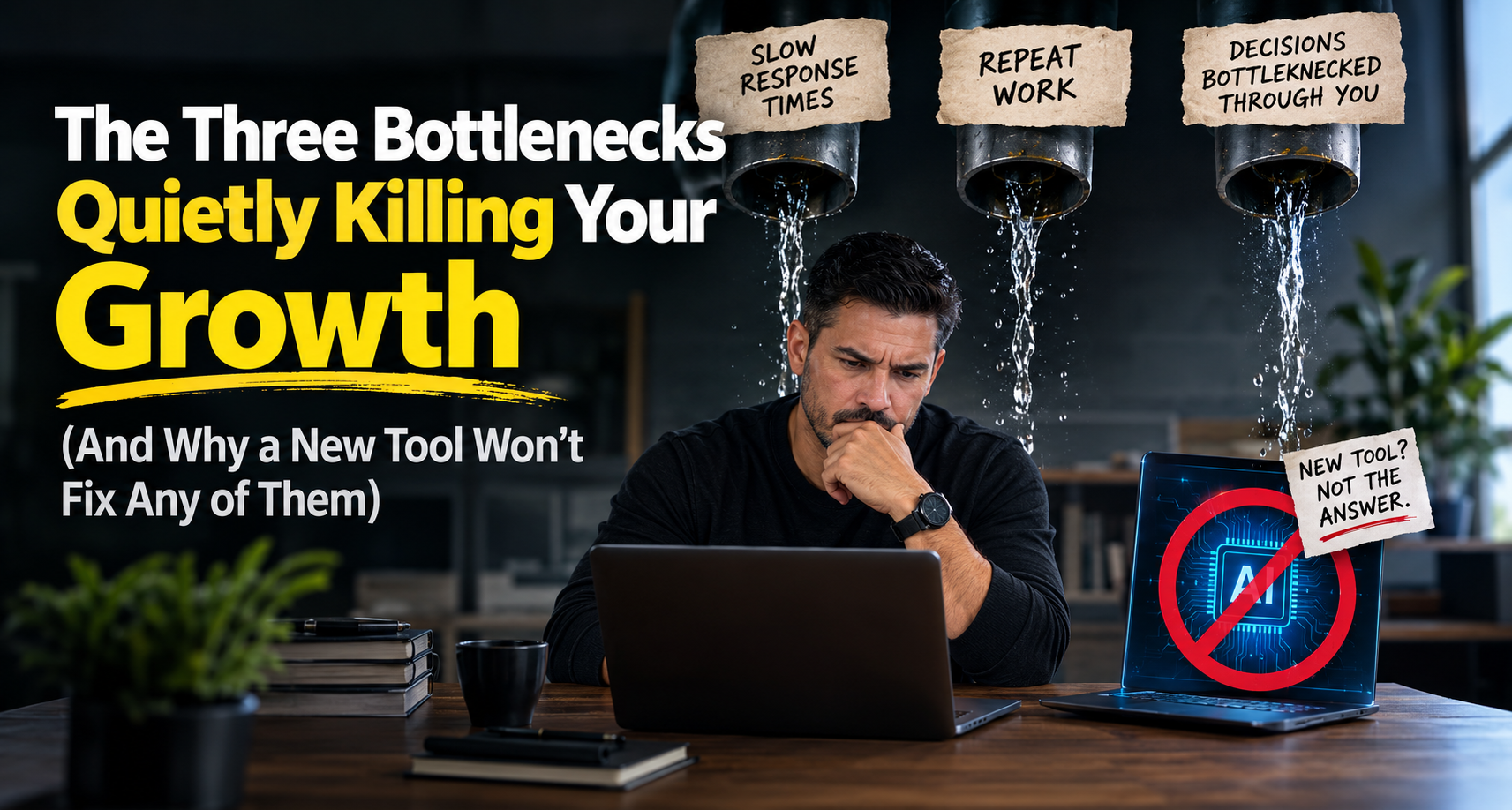
The Three Bottlenecks Quietly Killing Your Growth
(And Why a New Tool Won't Fix Any of Them)
Why hasn't adopting AI tools grown my business?
Most businesses that say they've adopted AI have done nothing of the sort.
They bought a tool. They watched the demo. They rolled it out to the team and sent the announcement. And six weeks later, the business runs exactly the way it did before — just with a new subscription line on the statement.
I don't say that as a criticism. I say it because I've watched it happen for decades, long before anyone called it AI. A team celebrates a system rollout, and the reports come out faster, and they land in the same inbox, waiting on the same person to make the same decision they always made. Nothing actually moved. We just sped up the part that was never the problem.
That's the trap. The industry sells adoption as the finish line, because a tool is easy to sell. But a tool dropped on top of a broken workflow doesn't fix the workflow. It speeds up the dysfunction. Now you're doing the wrong thing faster and paying monthly for the privilege.
Here's what I want to offer you instead, because it's the part nobody sells: growth doesn't stall in a hundred different places. In most small businesses, it stalls in three. And once you can name them honestly, the right fix usually becomes obvious on its own.
Let's walk through all three.
Bottleneck one: your response time
The business that answers first usually wins. Design replies so customers never wait on someone being free.
A customer reaches out. A lead fills out the form, or sends the message, or leaves the voicemail. And the reply goes out three hours later. Sometimes the next morning.
In a slower market, you could survive that. Everyone was slow, so slow was normal. That market is gone.
In a fast-moving market, the business that responds first usually beats the business with the better answer that took a week to send it. Not because the fast one is smarter — often it isn't. It's because the customer had a problem now, and someone answered it now, and by the time your thoughtful reply arrived, the decision was already made.
This is why I treat speed as the real moat. Not the flashiest offer, not the lowest price — the shortest distance between a customer reaching out and your business answering. Close that gap and you win deals you're currently losing without ever knowing they were in play.
And that's the quiet cost here. A slow response doesn't show up on any report. There's no line item that says "revenue lost to a four-hour reply." It just doesn't happen. The customer went somewhere faster, and you never saw the sale you didn't make.
You don't need a person glued to the inbox to fix this. You need the response itself designed so it doesn't depend on anyone being free in the moment — an acknowledgment that goes out instantly, a first answer that doesn't wait for you, a follow-up that fires on its own. The point isn't to remove the human. It's to make sure the customer never waits on one just to hear "we've got you."
Bottleneck two: the work you rebuild by hand every week
If a task is identical every time, set it up once instead of paying for it again every week.
Look at your week and find the tasks you do more than once, exactly the same way each time.
The intake questions you type out for every new client. The follow-up sequence you rewrite from scratch. The quote you rebuild, the onboarding email you copy-paste-and-edit, the weekly report you assemble by hand from the same four sources.
Most owners file all of this under "just part of running the business." I'd ask you to stop filing it there. Because that's not the cost of doing business. That's hours you're paying for twice — once when the work happens, and again every time it happens the same way it did last week.
This is the most reclaimable time in your entire operation, and it's the one owners overlook most, precisely because it feels productive. You're busy. You're doing the work. But repeat work that never changes is the clearest place to hand yourself back real hours without hiring a single person.
The test is simple: if a task is identical every time it runs, it shouldn't be run by a person who could be doing work only a person can do. The follow-up that always says the same thing, the report that always pulls from the same place, the reminder that always goes out on the same day — that's structure, not judgment. And structure is exactly what compounds. You set it up once, and it keeps paying you back every week for as long as the business runs.
Bottleneck three: you
When routine decisions wait on the owner, the business moves at the speed of one inbox. Keep the calls that need you; design the rest to flow without you.
This is the one that stings, so let me be careful with it, because I don't mean it as criticism.
You are supposed to be the center of direction. Setting where the business goes, deciding what it stands for, making the calls that genuinely require your judgment — that's the seat only you can hold, and no tool and no hire should ever take it from you.
But there's a different center you may have drifted into without noticing: the center of routine decisions. The small, day-to-day calls that still have to come back to you before anything moves. The discount that needs your yes. The schedule change that waits on your reply. The ordinary question the team already knows the answer to, but runs past you anyway because that's how it's always worked.
When that's the shape of your business, the whole thing moves at the speed of your inbox. You're not the CEO in that moment. You're the queue.
And here's the tension you have to hold, because it's the actual skill: hold too tight, and you become the ceiling on your own growth — nothing scales past your personal attention. Let go too far, and the business drifts without direction. The answer isn't "delegate everything," and it definitely isn't the push-button, owner-free business the hype crowd loves to sell. A real business still needs its owner's judgment.
The skill is knowing which calls actually need you — and designing the work so the rest flow without your daily sign-off. That judgment, the sorting of which-is-which, is the hardest part of running a growing business, and it's the exact thing most owners are quietly struggling with. Free up the routine decisions that don't need you, in order to protect your time and attention for the ones that genuinely do.
Notice what none of this required
None of the three is fixed by a new app. The hard part is the diagnosis, not the tool.
Read back through the three bottlenecks. Slow response times. Repeat work. Decisions bottlenecked through you.
Not one of them is fixed by buying a new app.
That's the whole point I want to leave you with. The hard part of this work was never the tool. Configuring the software is the easy part everyone fixates on, because it's concrete and it feels like progress. The hard part — the part that actually determines whether anything changes — is the diagnosis. Looking honestly at where your business is quietly costing you, and being willing to name it out loud.
People overestimate the tool and underestimate clear thinking about the problem. That's precisely why so many "AI projects" change nothing. The tool was never going to save a business that hadn't diagnosed what was actually wrong.
The three questions
Before buying more software, find where your time, customers and hours are leaking.
So before you spend another dollar on software, sit with three questions. These are the same three I've used for years to find where a business is bleeding:
- 01Where is your time going to repeat work — the tasks you rebuild by hand every week?
- 02Where are you losing customers to slow responses — the replies that go out hours after they should?
- 03And what manual task, if it disappeared tomorrow, would hand you back the most hours?
Each one points at a different cost. The first is your time. The second is your revenue. The third is your reclaimed attention as the owner. Answer them honestly, and one is going to sting more than the other two.
That's your starting point. Not the one that's easiest to fix — the one that hurts most. Name it accurately and, more often than not, the right fix is already sitting there in plain sight. When a bottleneck has more than one reasonable fix, take the simplest one that genuinely clears it, and decide for yourself whether to build something sturdier later.
I'm not going to sort those three for you, and I wouldn't want to. You know your business better than I ever will — its numbers, its rhythm, where it actually hurts. My job isn't to hand you a finished answer you don't fully understand, because a prescription like that falls apart the moment the situation changes, and the situation always changes.
My job is to sharpen how you look at it — so the call stays yours.
Start with the leak that hurts most. Everything else gets easier once it's named.
Common questions
Why hasn't adopting AI tools grown my business?
Because a tool dropped on top of a broken workflow speeds up the dysfunction instead of fixing it. Growth usually stalls in three places — response time, repeat work, and decisions routed through the owner — and none of them is solved by buying an app.
What are the three bottlenecks that stall small-business growth?
Slow response times to customers and leads, work you rebuild by hand every week, and routine decisions that have to come back to you before anything moves.
How do I fix slow response times without someone watching the inbox?
Design the response so it doesn't depend on anyone being free: an instant acknowledgment, a first answer that doesn't wait for you, and a follow-up that fires on its own.
Which tasks should I automate first?
Tasks that are identical every time they run — the same follow-up, the same report from the same sources, the same reminder on the same day. That's structure, not judgment, so set it up once.
Does this mean I should delegate everything?
No. Keep the calls that genuinely need your judgment, and design the work so routine decisions flow without your daily sign-off.
Where should I start?
Answer three questions: where your time goes to repeat work, where you lose customers to slow responses, and which manual task would hand you back the most hours if it disappeared.